BRAKE!!!
BRAKE!!!
Today is your driving lesson. Keep calm, obey all traffic rules—or get yelled at by your instructor!
How to Play
RT on a controller or Space on a keyboard to brake.
Your Goal
Travel 500 metres, obey traffic laws, avoid pedestrians, and finish with the highest score.
What we created
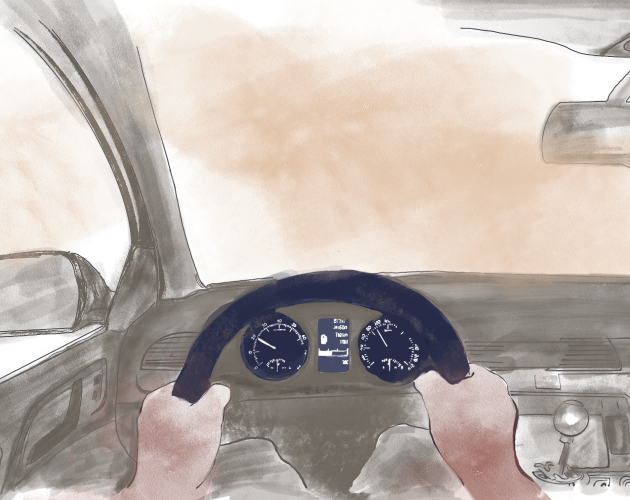
We created "Brake," a first-person video game that serves as a simple driving lesson simulation. We reasoned that the format of a driving lesson that focuses on stress as a mechanic was manageable for our team's expertise, fit the theme perfectly, and could be completed within our time limit.
The experience is designed to cater to multiple audiences. First and foremost, it is made for players who just want to play the game. However, it could also be used as a research tool to further explore how people respond when put under pressure. The game implements "stress" as a visualized meter influenced by the player's timing in controlling the brake. Changes in the stress meter then feed back as visual and audio consequences in the gameplay.
How It Works
The car accelerates automatically. Your only input is the brake, but using it well requires careful timing and pressure.
Stop signs, traffic lights, and jaywalkers create hazards along the road. Braking too suddenly makes the instructor yell and raises your stress. Waiting for more than three seconds triggers honking from the cars behind you, adding even more pressure.
The Idea and Concept
We wanted to simulate the experience of taking a driving lesson. The gameplay requires the player to pay attention to what's happening on the screen and react appropriately. The theme is emotion and its consequences, so we decided to make a game with a system that makes "stress" observable.
Though stress is not an emotion itself, a past study (Kemeny, 2003) showed that the experience of stress can affect our physiological systems, including the autonomic nervous system and the immune system. Immune cell products then act on our brain, creating emotional consequences that are made visible through our game.
Key features or decisions behind the final outcome
During brainstorming, we focused on the consequences of stress rather than all emotions, because we felt stress encapsulated a lot of emotions, such as anxiety, apprehension, fear, and concern. We decided to restrict the consequences of these emotions to an action, because within the context of a video game, we believed it would be harder to show non-action-based consequences. After reviewing these emotions, we decided to focus on stress because it had the highest number of consequences we were able to brainstorm.
It's all about stress and its consequences, so we decided to center our core mechanic around changes in stress level. Beyond random obstacles, we introduced some extra rules to account for the players' agency and possible attempts to test the game's limits. For example, stopping for more than 3 seconds triggers honking from cars behind, which then raises the stress level. We chose to integrate visuals and audio so the user gets a more immersive experience. We used AI, ChatGPT, to help with visual creation because of the time constraints of the project. The AI was fed real art pieces and drew inspiration from them.
Although "Brake" is designed to be stressful, both in its mechanics and on the user, the game's score is meant to incentivize the user to adapt to the game's mechanics and achieve higher scores.
The decision to include triggers that operate on a multisensory level (audio, visual, and mental) came from our understanding of how humans perceive stress (Harvard Health Publishing, 2024).
Development Note
To work within the 26-hour time limit, we used ChatGPT as part of our visual-creation process. The AI was provided with real artworks as visual references and used them as inspiration.
ChatGPT was used to organize and lightly revise the written content of the game description and to generate an HTML template with inline CSS for the Brake itch.io project page. The development team reviewed, modified, and approved the final content and design (OpenAI, 2026).
References
Kemeny, M. E. (2003). The psychobiology of stress. Current Directions in Psychological Science, 12(4), 124–129.
https://doi.org/10.1111/1467-8721.012
Harvard Health Publishing. (2024, April 3). Understanding the stress response.
https://www.health.harvard.edu/healthy-aging-and-longevity/understanding-the-stress-response
OpenAI. (2026). ChatGPT (September 16 version) [Large language model].
https://chatgpt.com/
Drive carefully. Stay calm. And remember to brake.
Leave a comment
Log in with itch.io to leave a comment.